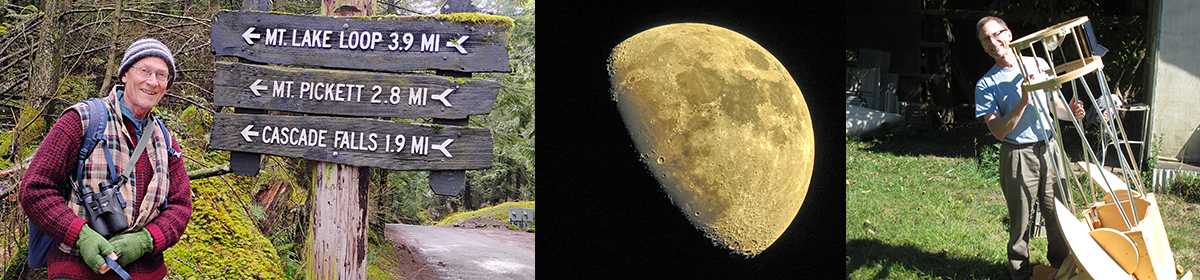
I love these cold clear winter nights standing under a dark moonless sky looking up at the stars. So familiar, so calming, so much a part of me. The Pleiades, Orion’s belt and sword, the Big Dipper pouring its contents out onto us. Tonight Mars, Jupiter, and Venus are visible across a broad swath of the Zodiac, the path of the planets and the moon. Sadly, just last week I missed the moon passing in front of Mars. Clouds, the perennial nemesis of the night sky observer. No special events planned for this week. But who’s to say when a shooting star might burst into view, illuminating the night like fireworks. Or a random sweep with my binoculars reveal a new deep space object. New to me that is.
We name the night sky objects based on imagination and based on scientific order. Early cultures chose names for planets associated with deities derived from their pantheon of gods and mythical stories. Jupiter, Venus, Mars, tonight’s heavenly guests, were Roman gods. Constellation monikers came from a variety of myths, legends, and other flights of imagination. But as scientists began to peer more deeply into the night, the names began to pile up and the need for more order was called for. It’s a long history of finding and cataloging but the end result became the “New General Catalogue Of Nebulae And Clusters Of Stars” or NGC in common usage. It delineates the properties for nearly 14,000 deep space objects with numbers and letters: distance, relative brightness, position and size, and other more esoteric properties. For example, there is a nebula in the constellation of Orion discovered in 1785 by William Herschel. He named it the “Reflection Nebula” because of its bright internal glow. Later, it became known as “NGC 2023.”
I kind of like the older names. Mostly because they hold a childhood romance for me. They speak to me somehow across the unfathomable distances from which the light we observe has traveled. Not words, not ideas, perhaps dreams, perhaps destiny. Not so much that we are destined to go there or they come here, whoever they might be, just that the night be included in our worldview, our umvelt. We are not whole without acknowledging the whole of our environment. My wife laughs at me, encouraging me to get my head out of the sky and focus on the work of protecting the environment we have right here on Earth. She’s right of course, there’s plenty to do here. But my heart and my imagination linger out there in the darkness knowing somehow that part of me is in touch with something greater than everything we have down here in this “gravity well” we call home.
Part of the magic are the distance scales. One summer night five years ago, some friends joined me to observe a comet in the sky. In one sweeping view we could see the waxing crescent moon, our closest neighbor; the comet, at that moment maybe ten times farther away than the moon but only 1/40 the distance to Sun; Saturn, 10x the distance from Earth to Sun; all the visible stars, which are as close as four light-years and as far away as 1,000 light-years; a globular cluster on the edge of our galaxy at about 22,000 light-years; the Milky Way, the center of which is 30,000 light-years from us; and finally the Andromeda galaxy, our nearest neighbor galaxy at two and a half million light-years away. We were dazzled by the immensity of so many distance scales. There are no mileposts out there. How can you know how far something is? They are all different brightnesses, different colors, scattered like dust across the sky. But astronomers have worked it out with a variety of clever techniques. It humbles me.
As I trudge back into the house to warm up and prepare for a good night’s rest, it occurs to me that I frequent the night sky less often. I’m 72 years old. I like my warm house and creature comforts. Perhaps the call of the night sky has dimmed for me, like my hearing and my eyesight and my creaky knees. Perhaps the imagination needed to “hear” the night sky calling dwindles with age like everything else. A muscle I am losing the ability to use. I don’t know the answer to any of this. But there is a wistfulness within me when I wake before dawn and catch a glimpse of the waning gibbous moon through the skylight, or when the Summer Triangle of Deneb, Vega, and Altair hangs high in the July night. Sometimes I rise, don enough clothing to not freeze and venture out to somehow rekindle that smoldering passion and feel whole again.